Raised Beds & Soil
How Far Apart Should You Space Multiple Raised Garden Beds?
How much path space to leave between raised beds for kneeling, wheelbarrows, and sunlight, plus a sample layout for small yards and larger plots.
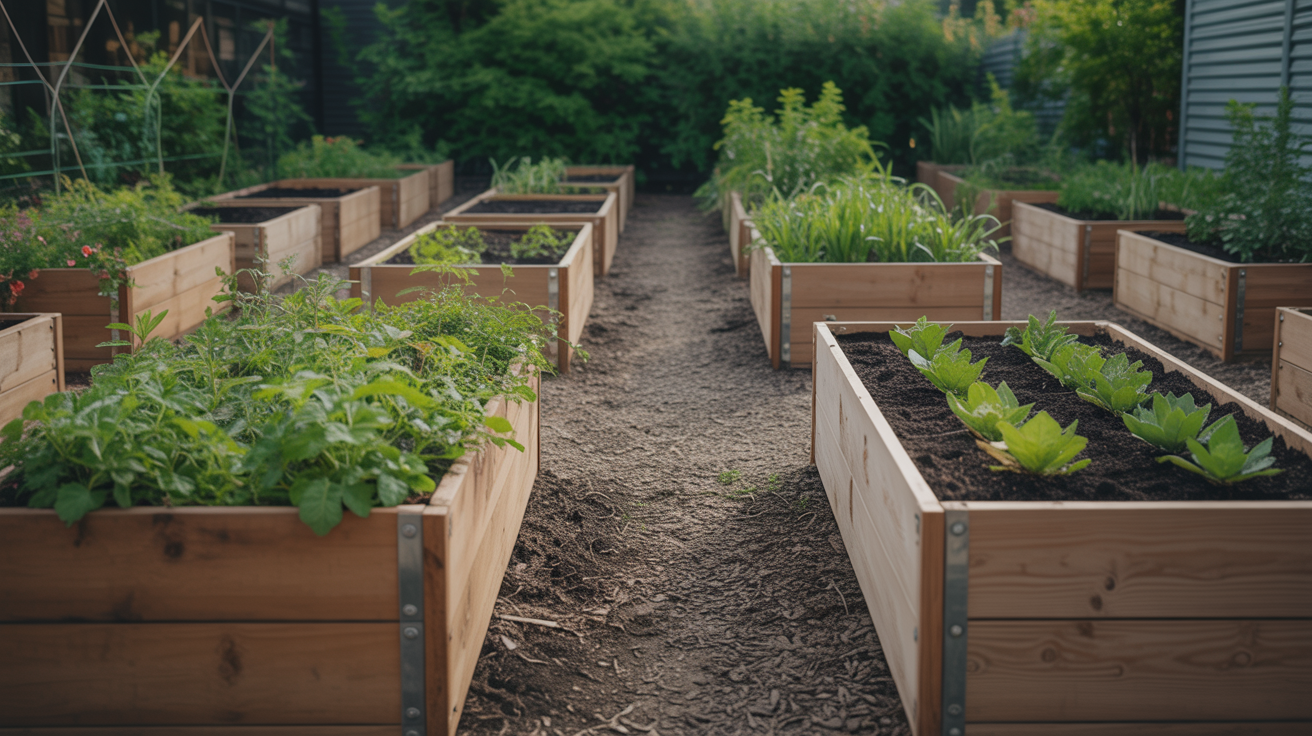
Once you're past your first single box, the question changes from "how do I build a raised bed" to something more like a puzzle: how many beds fit in this yard, and how far apart do they need to be so you can actually work them. Spacing between raised garden beds isn't just about how much lawn you're willing to give up. It decides whether you can kneel down to weed without landing in the next bed over, whether a wheelbarrow makes it down the row, and whether your tomatoes end up shading the lettuce all summer. None of this is fixed by a rule everyone agrees on, but there are working ranges that hold up in most yards.
How Wide Should Paths Be Between Raised Beds
For a path you'll only ever walk or kneel in, 18 to 24 inches is the working minimum. That's enough room to plant your knees at the edge of a bed without your feet landing in the soil of the one behind you, and enough to crouch and turn without knocking your elbow into the opposite frame. Anything narrower than that and you'll find yourself compressing the path soil into a hard little track, or worse, stepping into the bed itself to get room, which defeats a chunk of the reason you built a raised bed in the first place: keeping the growing soil loose and undisturbed.
If you garden with a bad knee, use a kneeling pad, or tend to spread out a harvest basket and tools beside you while you work, push that to 24 to 30 inches. It sounds like a lot of space to lose, but a path you actually enjoy using gets used more often, and beds that get visited often get weeded, thinned, and picked on time instead of a month late.
It also helps to think about how many sides of a bed you actually need to reach. A bed you can only approach from one long side, tucked against a fence or a wall, needs a comfortable path on that one side and can get by with a much narrower gap, even just a few inches, on the side nobody walks. A freestanding bed in the middle of a layout needs workable access on all four sides, which adds up fast once you're planning three or four beds instead of one.
Path Width for Wheelbarrows and Garden Carts
Kneeling room and hauling room are two different numbers, and this is where a lot of new layouts get tight in a way that only shows up after the beds are built and full of soil. A standard wheelbarrow measures roughly 24 to 26 inches across at its widest point, usually the handles or the wheel guard. A path sized exactly to that width means you're scraping both sides of the bed frames every trip, which chips paint, splits cedar edges over a season or two, and is simply annoying to do every time you haul compost.
Give a wheelbarrow path at least 30 to 36 inches, and make at least one path in your layout a true "main path" of 36 to 48 inches if you can spare it. That main path is where you'll haul in bags of soil amendment, wheel out spent plants at the end of the season, and where you need room to actually turn the wheelbarrow rather than back it out the way you came. A garden cart with a wider wheelbase needs the same treatment. If your yard is small enough that a full wheelbarrow path isn't realistic everywhere, it's fine to have narrower kneeling paths between most beds and reserve the wide path for one route through the middle.
How Bed Height and Orientation Change Your Spacing Needs
Height matters more than most first-time layouts account for. A low bed, roughly 8 to 12 inches tall, throws a short shadow that barely reaches past its own path even early or late in the day. A knee-high or taller bed, especially one packed with a trellis, throws a real shadow, and where that shadow lands depends on which direction the bed runs.
Beds oriented north to south tend to share sunlight more evenly across a row, because the sun tracks east to west overhead and each bed's shadow sweeps across its own paths rather than pooling on one side of a neighboring bed all day. Beds oriented east to west, especially tall ones, throw a shadow to their north side for a large part of the day. If you're stacking beds from south to north in a yard, put your tallest bed at the northern end of the layout. That way its shadow falls onto open ground or a path, not onto a shorter bed that needs the same sun.
This is also where spacing and bed height trade off directly: a taller bed sitting immediately south of a shorter one may need extra distance between them, sometimes an added 12 to 18 inches beyond your normal path width, to keep the shorter bed from losing its best light in spring and fall when the sun sits lower in the sky. In summer with the sun high overhead this matters less, but early and late season is often when a new gardener's crops need every bit of light they can get.
Avoiding Shade From Trellised Tomatoes and Pole Beans
A trellis changes the shadow math more than the bed itself does. A tomato cage or a bean trellis can add three or four feet of height on top of a bed that was otherwise low enough to ignore. Two habits solve most of the shading problems this causes. First, place trellised crops on the north side of your overall layout, not scattered through the middle, so their shadow falls off the edge of your growing area rather than across other beds. Second, if a trellis has to live in a more central bed, run it along the bed's own north edge rather than letting it span the full width, so the shadow it casts stays mostly within that bed's own footprint.
If you're not sure yet how much space vining and pole crops actually need within a bed, that's a separate question from bed-to-bed spacing. Plant spacing for vegetables covers how far apart to set plants inside a bed, which is worth reading alongside this if you're planning both a layout and a planting scheme at once.
Small Backyard vs. Larger Plot: Different Layouts, Different Priorities
In a tight backyard, sunlight usually wins over convenience. If you only have one sunny strip against a fence or along a driveway, you may end up with beds in a single row with 18 to 24 inch kneeling paths, and no full wheelbarrow path at all. That's a reasonable trade. You can haul soil and compost in five-gallon buckets or a narrow hand truck instead, a few extra trips rather than a wider path eating into your only good light. In this situation, resist the urge to squeeze in one more bed than the space comfortably holds; a fourth bed that leaves you with 12 inch paths will frustrate you every single time you go out to weed, and you'll likely find yourself avoiding the back bed altogether.
On a larger plot, you have more freedom to plan for comfort and future growth rather than survival-mode spacing. A grid of beds with 24 to 30 inch kneeling paths between them and one 4 foot main path down the center or along one side gives you room to add a bed later without redoing the whole layout. It's also worth leaving a bit of headland space, an open strip at the ends of your rows, so you can turn a wheelbarrow or cart around without cutting across a bed.
If you haven't settled on how many beds to start with in the first place, how big your first vegetable garden should be is worth reading before you finalize a layout, since the answer to that question shapes how much path space you'll need to plan for.
A Sample Layout You Can Sketch Out
Here's a layout that works for a mid-size backyard, three beds, each 4 feet by 8 feet, oriented north to south:
| Element | Dimension |
|---|---|
| Bed size (each) | 4 ft wide x 8 ft long |
| Path between beds | 30 in |
| Main wheelbarrow path (one side) | 42 in |
| Headland space at row ends | 3 ft |
| Total footprint (3 beds) | roughly 16 ft x 12 ft |
Picture three beds set side by side, running north to south, with a 30 inch kneeling path between the first and second bed and again between the second and third. Along one outside edge, run a 42 inch path, wide enough for the wheelbarrow, connecting to the shed or gate. At both ends of the row, leave a 3 foot strip of open ground so you can turn the wheelbarrow rather than wheeling it straight into a bed. If you're adding a trellised bed for pole beans or tomatoes, put it at the north end of the row so its shadow falls away from the other two beds rather than across them.
Scale this up or down based on your own yard. The proportions matter more than the exact numbers: kneeling paths at a comfortable 18 to 30 inches, at least one path wide enough for a wheelbarrow, extra room at the ends for turning, and taller or trellised beds placed where their shadow does the least damage. If you're building beds from scratch and haven't picked dimensions yet, our step-by-step guide to building a raised garden bed covers common size options that pair well with these path widths.
Frequently Asked Questions
What is the minimum spacing between raised garden beds?
Eighteen inches is workable for a path you'll only kneel and walk in, though 24 inches is more comfortable if you use a kneeling pad or carry tools and a harvest basket with you. Anywhere you need a wheelbarrow or cart through, plan for at least 30 inches.
Does a wider path waste growing space?
Some, yes, but a path too narrow to actually use comfortably costs you more in the long run. A bed you avoid weeding because the approach is cramped produces less than a slightly smaller bed you tend regularly.
How do I stop one raised bed from shading another?
Orient beds north to south where you can, and place your tallest or trellised beds at the north end of the layout so their shadow falls off the growing area instead of across a shorter bed to the north of it.
Can raised beds sit right next to each other with no path at all?
Technically yes, if you plan to reach every part of both beds from the outside paths on their far sides, but it's rarely practical once plants fill in. Even a narrow 12 to 18 inch gap makes weeding, harvesting, and airflow between beds noticeably easier.
What's a good material for the paths themselves?
Wood chips, straw, or landscape fabric topped with gravel all work well and keep weeds down better than bare soil, which tends to compact into a muddy strip after repeated foot traffic and watering runoff from the beds.